
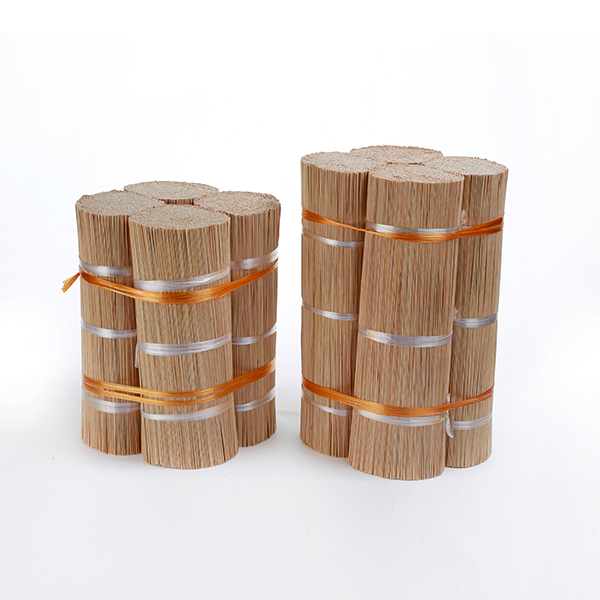
Fragrant bamboo sticks: the method of adding fragrance and the significance of the number of sticks
The number of incense sticks is divided into 1, 3, 4, 7, 9, 12, and 36 columns. Perhaps there are other roots, but these are the most common ones. Let's first talk about the meaning of these roots.
1. When it's like a fragrance, few people go up. Because one root represents the unity of all Dharma, disciples who are not proficient in the Dao dare not go up. Because assuming that the Dao is good or not, the immortal family who came to provoke will just wait to get hurt. And those who come to provoke are all righteous immortals. Why? Because the immortal path has such rules: if someone takes a stick of incense, it indicates that they have attained enlightenment and become upright. Other immortal families can come here for consultation to verify whether their path is deep enough to meet the requirements of the righteous god. So there are very few disciples, it can be said that there are almost none. Everyone, don't just stick to a stick of incense to avoid damage.
2. Three sticks of incense are the standard way of offering incense in Buddhism, representing the conversion to the Three Treasures, sincere cultivation, detachment from reincarnation, and survival in the West. Taoism also uses three incense sticks, representing the Three Pure Ones or the Three Laws of the Six Harmonies.
3. 4 sticks of incense, mostly worn by disciples who practice at home or those who go on horseback. The layman who practices at home has four pillars, the fourth pillar is the protective incense, and some are ancestral incense. inequality. The disciples who set out on horseback offer the Four Pillars Incense, representing their willingness to join the immortal family in converting to Buddhism, practicing and ascending.
4. The 7 pillars and 9 pillars are mostly the ones that the disciples usually climb. The 7 pillars represent the Big Dipper. The Nine Pillars of Incense account for the Six in One method, so most of the disciples on horseback use the Nine Pillars. The laypeople and Taoists who practice Buddhism and Taoism also have nine pillars, with three pillars forming one pillar, which has the same meaning as the three pillars of incense.
5. The 12 pillars are half full incense, often used by disciples on horseback to observe events. The 36 pillars are full incense and are also used by disciples on horseback to watch events, but they are rarely used unless the situation is urgent and serious.
Let's talk about the method of offering incense again: it is necessary to wash hands before offering incense, it is necessary to light incense with candles, and after lighting incense, bow three times. In Buddhism, three kowtows and nine bows are performed as a grand ritual. But usually, bowing three times is enough.
Offering incense to Buddhas, Bodhisattvas, immortals, and ancestors. For Buddhists, it is necessary to recite Buddha with integrity in order to communicate with Buddhas and Bodhisattvas and receive blessings. Taoism uses incense wax to worship the gods of the heavenly realm, human realm, and land realm, not only to show respect for the gods, but also to communicate with the people of the Three Realms and Six Harmonies. The function of offering incense can be divided into two categories: one is to pray for blessings to the gods, and the other is to offer sacrifices to the ghosts and gods in the underworld. However, regardless of which type of deity is offered incense, an odd number of incense will be burned, that is, one incense will be burned. Three. Five. Seven. The fragrance of nine. Single is a yang number, and yang represents great respect. Representing the reason why Buddha and gods are revered by humans.
A single stick of incense is a fragrance, usually worshipped by gods at home, only seeking the smooth flow of everything for each family member. Drinking a fragrant incense every morning and evening is enough!
The three incense sticks are the Three Treasures Incense, and the so-called Three Treasures are the Buddhist monks. Buddha is the complete Buddha, and Dharma is the Buddhist scripture. A monk is a fallen haired monk.
The Taoist name is San Qingxiang, which refers to the Jade Clear Primitive Heavenly Zun, the Clear Clear Spiritual Treasure Heavenly Zun, and the Taiqing Moral Heavenly Zun.
Xianjia is called Tangkou Incense, and one of the Three Clear Incense is called the Main Incense, which is called the Master Incense. The one on the left is called Qinglong Incense, and the one on the right is called Baihu Incense. Insert a bottle of "Baoma Xiang" on the left side in front of Sanqingxiang. This is for Lingying to report the disaster outside the entrance of the Ma Protection Hall. To worship Buddhas and Bodhisattvas, one is to worship the gods, which is the main incense of the Three Pure Teachings. In Buddhism, a incense called the Three Treasures Protection Incense can be inserted in front of the three incense sticks, while in Taoism, it is called the Three Pure Protection Incense.
The Five Incense refers to the Six in One Five Elements Incense, abbreviated as Yin Yang Five Elements Incense. There are two ways to place the Five Elements Incense, one of which is to arrange it according to the five directions. To the left is the fragrance of Qinglong, and to the right is the fragrance of Baihu. The first one is Vermilion Bird Fragrance, and the second one is Xuanwu Fragrance. Another way is to arrange five incense sticks in a straight line horizontally. The Five Elements Incense is a method of burning incense used by shamans to guess good or bad luck or summon gods. The left fragrance is called Qinglong, the second fragrance is called Baihu, the third fragrance is called Guankou fragrance, the fourth fragrance is called Hufa fragrance, and the fifth fragrance is called Baoma fragrance. Bao Ma Xiang serves as a messenger for the leader of the sect. Protecting the high and bright fragrance brings disaster, while the high and bright fragrance of Qinglong brings good fortune.
The seven fragrances are the Big Dipper Seven Star Fragrance; These seven stars are called Tian Shu Tian Xuan Tian Ji Tian Quan Kai Yang Yu Heng Guang. The Seven Star Incense is a call to the gods, soldiers, and generals, unless absolutely necessary.
Nine sticks of incense make up nine nine linked incense sticks; It takes 33 days to reach 33 places. It is an invitation from above, and from below, it is an invitation to the Ten Halls of Hell. The information incense that once called for help, if not necessary, has no way to seek help, and manpower can no longer save it. I hope that the ten halls of Yama's spiritual rhinoceros can come to life and save the suffering. The nine incense sticks are usually arranged in a three by three arrangement.
Usually, when worshipping Buddha and gods at home, one makes a vow in the hope of receiving help from the gods. Accelerate the achievements of one's aspirations, protect one's home, be happy and content, have good health, have successful children, have abundant wealth, and have a prosperous career. All one desires will be fulfilled. Red luck is at the forefront, everything runs smoothly!
Article source: Fragrant bamboo stickshttp://www.qianzhuhang.com
-
10-30
What should I do if bamboo sticks get moldy in humid weather?
According to natural bamboo raw materials, it is very easy to mold during humid weather and climate, especially during the spring, summer, and dry seasons. Continuous rainy weather for several days in
-
10-29
What are the meanings of the number of sticks used to make incense sticks?
The number of incense sticks for worshipping gods and Buddhas is generally one or three, and can be adjusted according to special needs, with a maximum of 108 sticks of incense sticks. Its significanc
-
10-28
Xiangxin Factory teaches you how to judge the quality of bamboo stick incense
Bamboo stick incense is a fragrance we often use, but many people don't know how to judge the quality of bamboo stick incense when buying it. For this reason, the incense stick factory teaches you how
-
10-27
What other types of fragrances are there besides bamboo stick fragrance?
At present, the hygiene incense in China can be classified into four categories: "stick incense and tower incense that southerners like to burn" and "string incense and pan incense that northerners li